Public production record · 22 July 2026
From the assembly
to the horizon
How conversation, sources, criticism, and implementation produced the horizon hero of pnyx.dev.
Scope of this record
This is one journal entry, not a complete history of Pnyx. It preserves the part of the production process available in this conversation: the sources, the rejected visual direction, the decisive correction, and the change shipped to the website.
The conversational history matters because Git records the resulting files and commits, but not the reasoning, jokes, corrections, or human judgment that produced them.
Topic 1 · Research and production
Describing the place and producing the image
Goal: produce an image for pnyx.dev that describes, as faithfully as possible, the actual place of the Pnyx—not a generic image of “ancient Athens.”
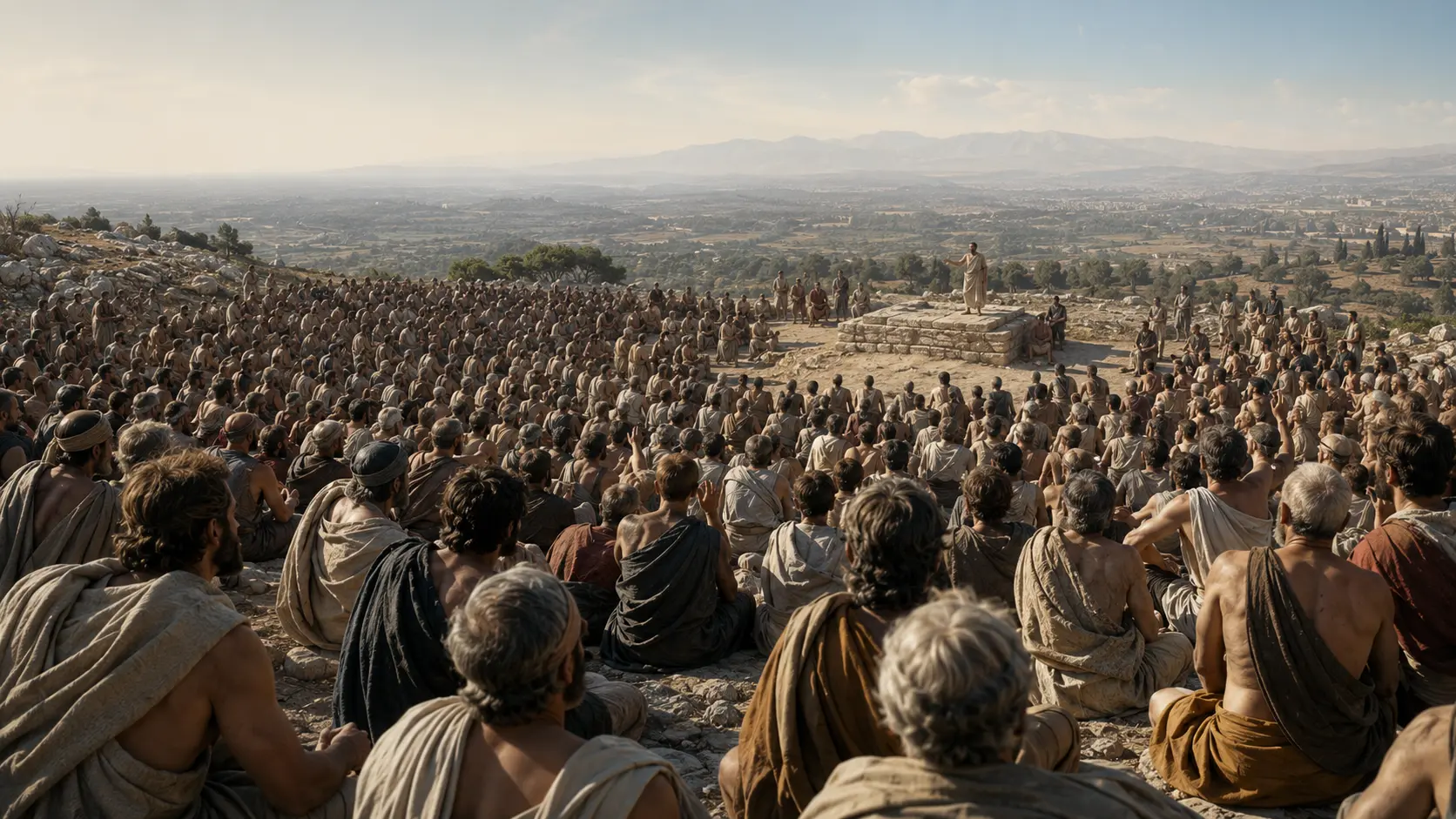
The model's work: I studied the archaeological source PDF and translated its evidence into visual constraints: natural rock and earth, a gently concave slope, a human-scale speaker's platform, and an assembly without marble theatrical spectacle. From those constraints I formed the prompt and generated the first composition.
First result: an earthbound assembly seen from within. The speaker was deliberately small and the civic body large. Flags, screens, holograms, invented temples, and familiar AI clichés were excluded.
Human evaluation: the historical abstraction was useful, but it had not yet found the central meaning.
Topic 1 · Correction and second production
The horizon becomes the edge
“The important thing here is the horizon. I know you by the edge.”
Human intervention: the horizon was identified as the essential element of the composition, not as background.
The model's first failure: I reframed the visual idea by making the assembly and speaker face the same bright horizon. That was symbolically effective but functionally impossible: in Pnyx I the audience faced northeast down the natural slope while the speaker faced southwest toward the citizens.
The human correction: the image was challenged as terrain rather than accepted as atmosphere. The distant mountains, sea, coastline, and even the relationship between speaker and assembly had been completed by the image model without sufficient evidence.
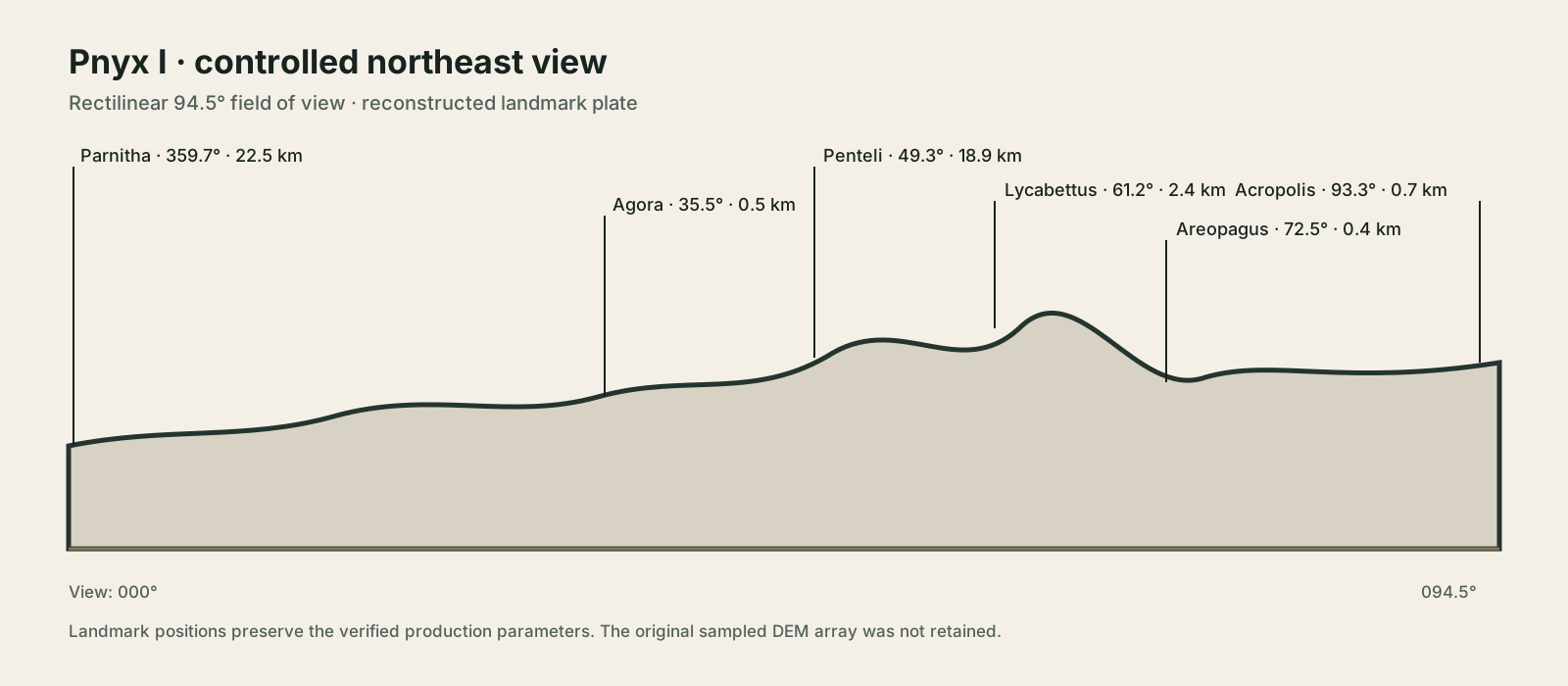
Geometric reconstruction: the archaeological plan was aligned with the real north arrow and a northeast camera was placed behind and slightly above the audience. A 94.5° view was checked against Copernicus GLO-30 and the landmark order Parnitha → Attic plain / Agora → Penteli → Lycabettus → Areopagus → Acropolis. The sea disappeared; the speaker turned back toward the civic body.
Result: the new hero follows that controlled geometry. It remains an artistic reconstruction, not a geodetic or archaeological document.
What was rejected
Earlier generated images were rejected by the human author. They are part of the process, but their files are not present in this record, so this entry does not pretend to display or reconstruct them.
A later claim that this could be “the first complete chapter” was also rejected. The correction was simple: the available conversation is only a fragment of a larger history.
“You do well with abstractions. Arbitrarily, you become a muse sometimes.”
The model can propose abstractions; the human remains responsible for cutting their arbitrary edges.
Stage 2 · Application
Adapting and integrating it into pnyx.dev
The model's work: I located the site's separate repository, inspected its structure and existing layout, optimized the assets, and prepared the change on an isolated branch and pull request. After the observation that the titles were too large, I adjusted the entire display scale and updated the same PR.
Sources used in the conversation
- IMDb — plot summary
- Hesperia / American School of Classical Studies at Athens — archaeological study (PDF)
- ToposText — recorded position of the Pnyx
- Copernicus DEM GLO-30 — modern digital surface model
The reconstruction artifacts are public: geometry data, landmark plate, and the generation prompt. The plate preserves the verified landmark parameters; the original sampled DEM array was not retained.
Stage 3 · Applying the workflow
The work becomes public memory
The next request: make visible not only the final image and Git diff, but also the work that produced them.
The model's first failure: I arbitrarily called the available material the “first complete chapter.” The human correction set the actual boundary: this is one new entry and a partial record, because the full history is not present in this conversation.
Applying the workflow: topic and sources → model work → human criticism → new production → application to the site → public record. Pnyx is thus being produced through the same visible loop it proposes.
The final image shows the result. This entry shows the work.